 AiW note: Afritondo is a media and publishing platform which aims to improve diversity in publishing by offering African and Black minority writers a platform on which to tell their stories. Afritondo publishes stories, essays, commentaries, and poems by established, budding, and aspiring writers, as well as books and anthologies.
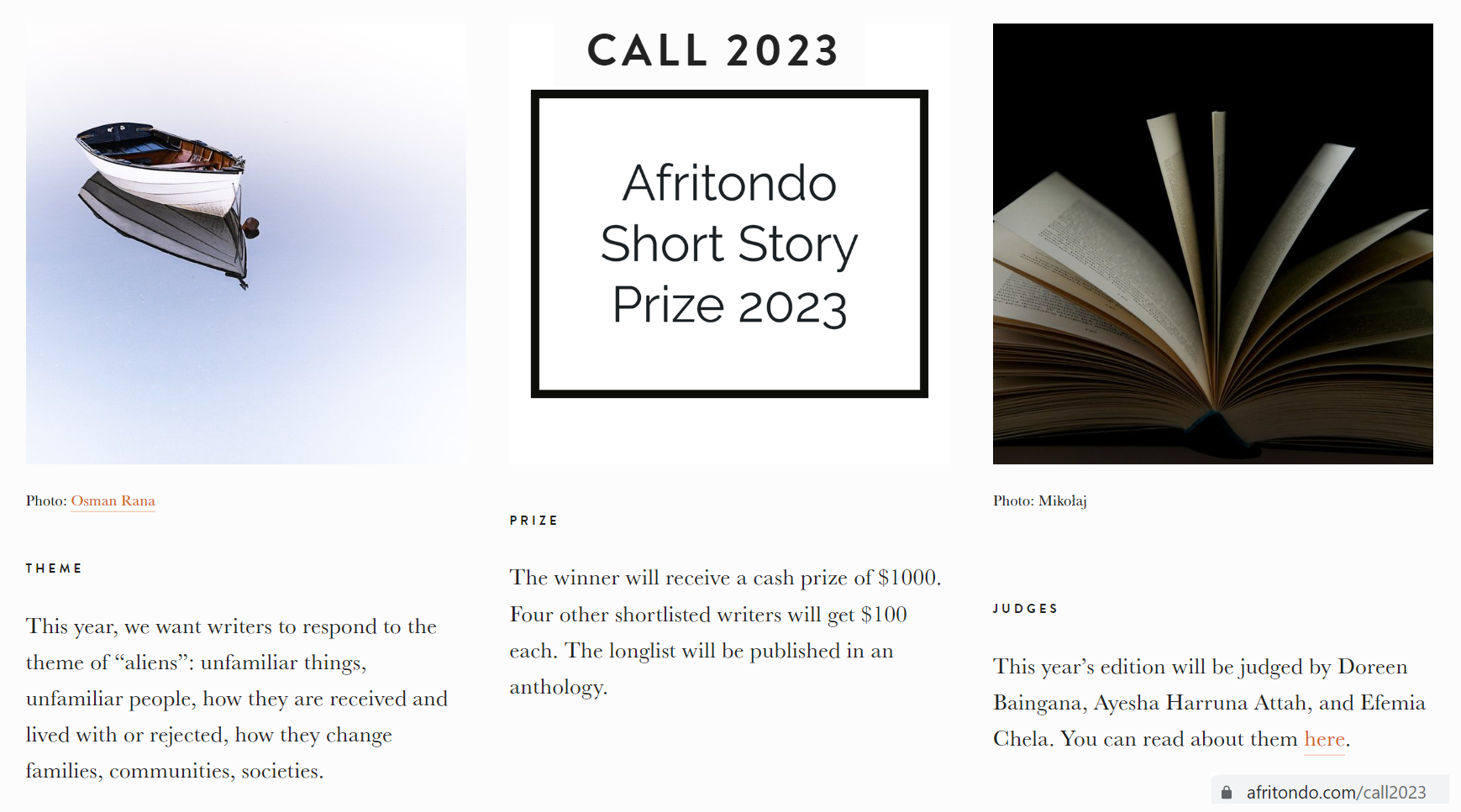
Afritondo also runs a short story prize, which is now in its fourth year. For those entering this year’s edition, judged by Doreeen Baingana, Ayesha Harruna Attah, and Efemia Chela, there is time: competition story submissions, on the theme ‘aliens,’ need to be with Afritondo by December 16th, 2022 to be considered for the 2023 prize. Otherwise, be on the lookout for the Prize anthology, collecting stories that explore “unfamiliar things, unfamiliar people, how they are received and lived with or rejected”, all as agents of change, due out next year.
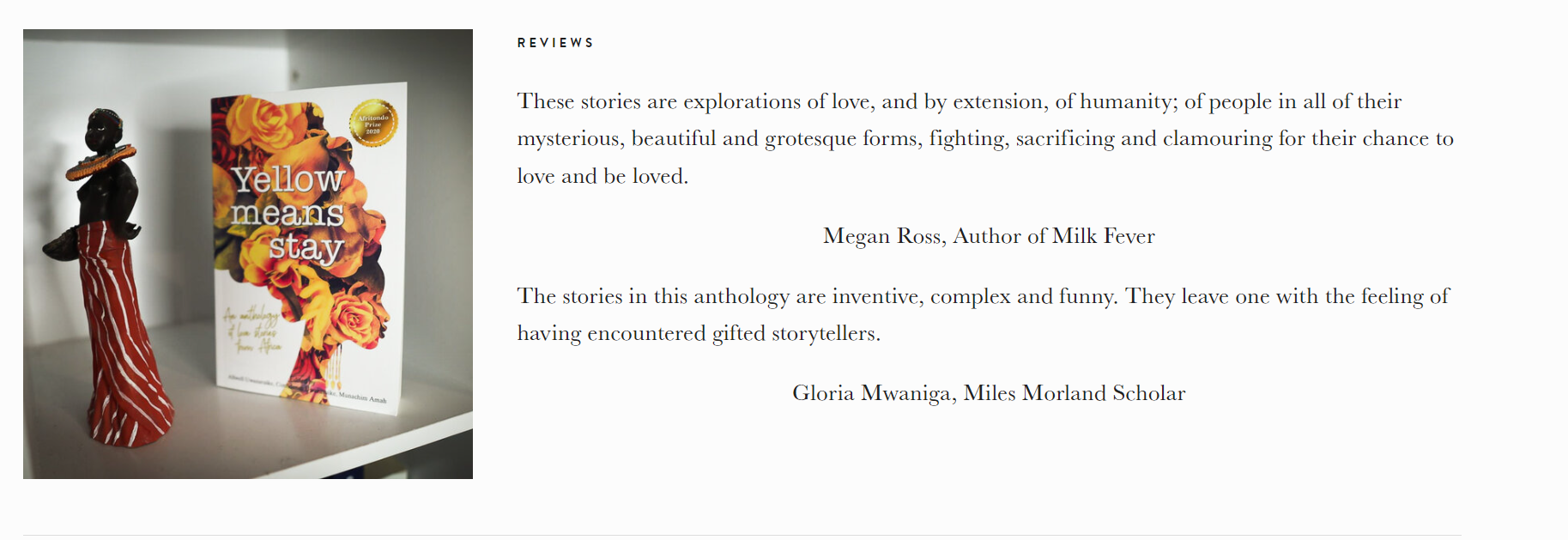
Here, Davina Philomena Kawuma, Contributing Editor with us at AiW, reviews the inaugural prize anthology Yellow Means Stay: An Anthology of Love Stories from Africa (2020) – edited by Allwell Uwazuruike, Confidence Uwazuruike, and Munachim Amah – and discusses her experience of her own story, ‘Touch Me Not,’ which is included in it.
The review takes two parts: while the first takes us along with Davina as a writer, traveling the collection from the seed of the story’s germination to the arrival of the book at the post office, the second, in a listicle form, leans more into the reading experience, with feature snapshots of the 20 other stories in the anthology (that are not her own), and the writing they each contain.
Both parts explore the thematic complexities and variation of craft collected by Yellow Means Stay. A critical-creative, creative-critical review of the collection and of individual experience, then, the review follows a path through Afritondo love as a reader and a writer, or more specifically as a writer-as-reader, intimately relating the two.

I.
One of my favourite books to reread is Rainer Maria Rilke’s ‘Letters to A Young Poet.’ I’m a sucker for anything written in the epistolary form, and for feedback that’s as blunt as it is gentle. To wit:
…may I just tell you that your verses have no style of their own, although they do have silent and hidden beginnings of something personal. I feel this most clearly in the last poem, “My Soul.” There, something of your own is trying to become word and melody (p.5).
Rilke advises that we write as single-mindedly about the mundanities of daily routines as we do about grand themes like love. He also speculates about what it might mean to love (and be loved) by another, not as females and males, but as human beings – how this might free love from narrowness in sexual feeling, wildness, and maliciousness:
For one human being to love another human being: that is perhaps the most difficult task that has been entrusted to us, the ultimate task, the final test and proof, the work for which all other work is merely preparation (p.24).
I’m often reminded of Rilke’s words during wedding ceremonies; invariably, someone, usually the officiating minister but sometimes a pontificating in-law, will quote 1 Corinthians 13:4-8 to remind guests that love is “hard work” – much more than something merely said or felt. Such reminders are often gender-specific: be patient, kind, and humble (if you’re a woman), and manage your anger better (if you’re a man).
In less ceremonial spaces, warnings about how hard love is often segue into debates about sex – sex as impulse, sex as role, sex as category, and especially sex as bodily activity. I’m therefore hardly surprised when, one warm night, after our weekly readers/writers meeting, a writer friend pauses his tea-drinking and groundnut-chewing to say, “Men use love to get sex and women use sex to get love.”
Months-long puzzlement over that deadpan announcement gives birth to a short story, ‘Touch Me Not,’ which, months later, I submit to the 2020 Afritondo Short Story Prize. The story is later published in ‘Yellow Means Stay,’ a copy of which I excitedly collect from the post office as soon as I’m notified via text message that I’ve received a package.
I’m ALWAYS nervous about seeing the printed versions of my stories because I ALWAYS catch things that I miss in the Word document versions, while they marinate in folders on my desktop. As I scan the contents page, I’m overcome with dread. What if I realize that I should have used a comma, instead of an em dash, in paragraph X? Or, horror of horrors, what if I used an en dash instead of an em dash?!
With relief, it seems my story sits carefree and happy between Joshua Chizoma’s ‘Of Dead Things That Come Alive’ and Abimbola Alaba’s ‘The Seeds of Pomegranates.’ Yet I still cannot bring myself to read it, not even after several pep talks guaranteed to assure myself that the world won’t come to a premature end because I misplaced a comma. So I focus on the other stories instead, eager to discover what other writers have brought into and/or taken from the theme, content to first read the collection primarily to learn how to write fresh.
A quick flip through reveals that the collection represents writing from Nigeria, South Africa, Ghana, Kenya, Lesotho, Namibia, the United Kingdom, the United States of America, and Zimbabwe, each prefaced by an accompanying pithy proverb – listed through the text as African, Jamaican, Kenyan, Liberian, Cameroonian, Egyptian, Ghanaian, Congolese, Tunisian – which anticipates, but doesn’t give away, the contents. What follows are my musings, as I wander through the stories on my way back to my own (from Uganda, with an introductory Kenyan proverbial) in its new surroundings…

I start at the beginning, with the protagonist of the first story in the collection, Rémy Ngamije’s ‘Only Stars Know the Meaning of Space’ – a star revelling in her role as muse and girlfriend:
I’ve been loved by men before. None of them have been artists. To be loved by someone who creates, who does, who tries to communicate his innermost being for a living is akin to being present during the First Seven Days. Can you imagine bearing witness to the awesome powers and the creation of life? It’s intoxicating” (p.2).
And so, as I venture into Philani Nyoni’s ‘Slick Dog Diary of a Ninja’ next, I’m intoxicated with images of being loved by, and pro-creating with, an artist. Ahem. And I discover that my intention to read the stories in the order in which they appear is foiled. Within the first few paragraphs, Nyoni’s story is doing something I’ve struggled for a while to pull off, which is to speak true to pronunciation away from an English dictionary – mother tongue interference means that in real life I pronounce ‘bird’ exactly how I pronounce ‘bad,’ ‘bud,’ ‘bard,’ and ‘burred.’
How can I write like this and still make creative sense? I often wonder – but here it comes across in a way I’ve never anticipated.
It quickly becomes clear that I’ll have to read Nyoni’s story extra-slowly if I’m to properly absorb what’s happening. So I fold the page in half, make a few notes in the margin, and adopt a haphazard plan, picking what to read next with as much randomness as I’d choose what channel to watch on a lazy Sunday afternoon. The arbitrariness of my approach is belied by the purposiveness of the stories. Underpinned by the editorial intent to collect narratives “set wholly or partly in Africa,” which “offer novel insight into the theme” and “challenge the art of storytelling,” the stories confront the thematic criteria of the prize in a range of subjects that have at one or another point preoccupied me, but which I haven’t necessarily figured out how to properly treat in fiction.
Yellow Means Stay is a collection that reveals the success of its own terms throughout, and offers several takeaways about lessons in writing – how to develop a backstory; how to use a conversational tone to lull your readers into forgetfulness; how to approach topics like bulimia, which are so seldom discussed where I’m from; how to use poetry to express the inexpressible. Touch, awakening, and seeding are three of several metaphors through which popular [mis]understandings of the texture of love are stretched, kneaded, and twisted to alert readers to the ways in which the giving and receiving of love is as much a natural reaction, an instinctive fulfilment of desire, as it is a product of artificial boundaries – of too much or too little socialisation.
Love is here as a spiritual and bodily home, forming personal and collective histories, both in and out of this world and its times. We find love in and as international relations, politics and neo-colonialism – historically, presently, and in speculative futures – in the ethical debates surrounding future diasporas and telecortex technologies. It makes itself known as variously forbidden, queer and straight, also present as weaponry, and recurrently as a reminder that things are seldom what they seem.
It is piety, obligation, and burden; both the “long-awaited answer to a sinking man’s fervent prayers” (p.271) and a bridge away from God: “but this time, by unfollowing him” (p.201). Overlaid with grief, nationalism, and incestuous overtones, there is love that takes us places – realms where social morays and physical expressions, as we currently understand them, are ecstatically superseded – but also finds itself with nowhere to go, in grief, loss, and sickness.
I also find love, loveliness, in the innovative ways it is narrated: the whole of Kojo Obeng-Andoh’s ‘[Unknown] and Wife’ unfolds through a single sentence whose paragraphs are connected by several semicolons. (Easily my favourite punctuation mark, I’m overjoyed to encounter so many semicolons in one story, and to consider how they add a note of effortlessness and movement to the plot.) The epistolary, another one of my favourites, in Chizoma’s ‘Of Dead Things That Come Alive,’ proves the form’s power to evoke separation and togetherness as the protagonist, “a man on a journey” (p.77) agonises over regret, infidelity, and seduction. And as I laugh my way through Cynthia Kistasamy’s ‘Shiva Eyes,’ an appreciation of the roles that irony and defiance, humour and its unpredictability, play in the storytelling of love resonates back through all my reading.
But it is to the intrigue of the uneven text alignment in Phillip Leteka’s ‘The Beast and the Boy Who Lives Close to My House,’ that I pay special attention, as this is something I’ve previously experimented with (albeit to mixed results). I note how the visual aspects of Leteka’s textual patterning works with the blend of poetry and song to express deep and forbidden feelings, relaying the concession of the protagonist that the durability of his relationship with the boy that lives on the adjacent street depends on much more than his perspective:
Now the seed sprouts and receives a sparkle of light
This soil has nurtured, a fruit loathed by the prophets
As you search with your hands know which land is forbiddenWhat of this fire, what of butterflies?
Kill the flame, cast away the moths
Will you see it through to the end? (p.168)
So when I finally circle back to ‘Slick Dog Diary of a Ninja,’ it is with greater appreciation of its idiosyncratic language and cheeky word play. Although Slick Dog’s ‘Diary’ uses its first beats to explain why he had sex with Mary – “I swear arm sitting not lying, God would heat that also” (p.19) – this doesn’t deter Mary’s brother from confronting him about sleeping with a “skull girl” (p.28). Slick Dog immediately goes on the offensive:
He says to me again that I do a crime and me I ask him what is not cold crime here? A person can go to skull, even university but cunt get the job, then his selling bananas and airtime for phoning but police come and hit him like he still a First Lady panty. Even police law say polices cunt hit but try and see. Now law say skull cunt hit childrens but everybody know that is talking crazy cause it always happen. What is not cold crime, city council can right a sign on the road that water is life but come and close the water if you cunt pay because you got no job. (p.29)
“Me I tell him this is jungle, everything a crime here,” (p.30) Slick Dog argues.
The play on [mis]spelling and [mis]pronunciation throughout the story troubles consent, agency, the conflation of physiological maturity with emotional maturity, and racism; it also expands the careful and thoughtful commentary on several issues – religious belief, social injustice, violence – multi-facets of love highlighted by the collection.
By the time I am through, my copy looks much older than its age; there are furious notes in the margins, and several underlined paragraphs. Most of the pages that aren’t folded in half have dog-ears. It’s unlikely that this copy will be borrowed or read by anyone else. But maybe that’s not such a bad thing, since I intend to leave notes, by myself, for myself, as I return to my own story, that I wouldn’t want anyone else to read.
‘Touch Me Not’ is narrated in the third person because of a challenge I set for myself: the third person point of view is my least favourite; I find it especially demanding – in the absence of force or reward, I will go to extraordinary lengths to avoid writing stories in the third person. As I re-read ‘Touch Me Not,’ I remember how much I enjoyed writing the relationship between my unnamed characters, ‘She’ and ‘he,’ which starts online and culminates in a physical meeting at She’s house; She’s and his feelings of desire and attraction throughout the story are meant to mirror the reaction of the touch-me-not plant.
It seems important, in a way that wasn’t important while I wrote the story, to choose a favourite part. It surprises me to learn that my favourite part is the ending, when he asks to see She’s garden, and She responds by leading him to a place fenced in by moonflowers, double-flowered Hibiscus, large-leafed gardenias, Spanish bayonets, and Mexican flames: “She pauses by the mango tree and points to the container of space behind its breathing roots, which are long and lacy like the December rain. ‘That’s my spot’” (p.101).
Although I stumble upon a misplaced semicolon or two, I’m not as alarmed as I would ordinarily be: in Yellow Means Stay, my story is one in a collection through which the difficulty and joys of loving as human beings can be explored in the boundless ways listed above – in all complexities.
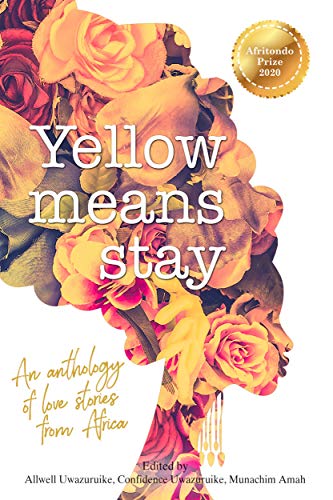
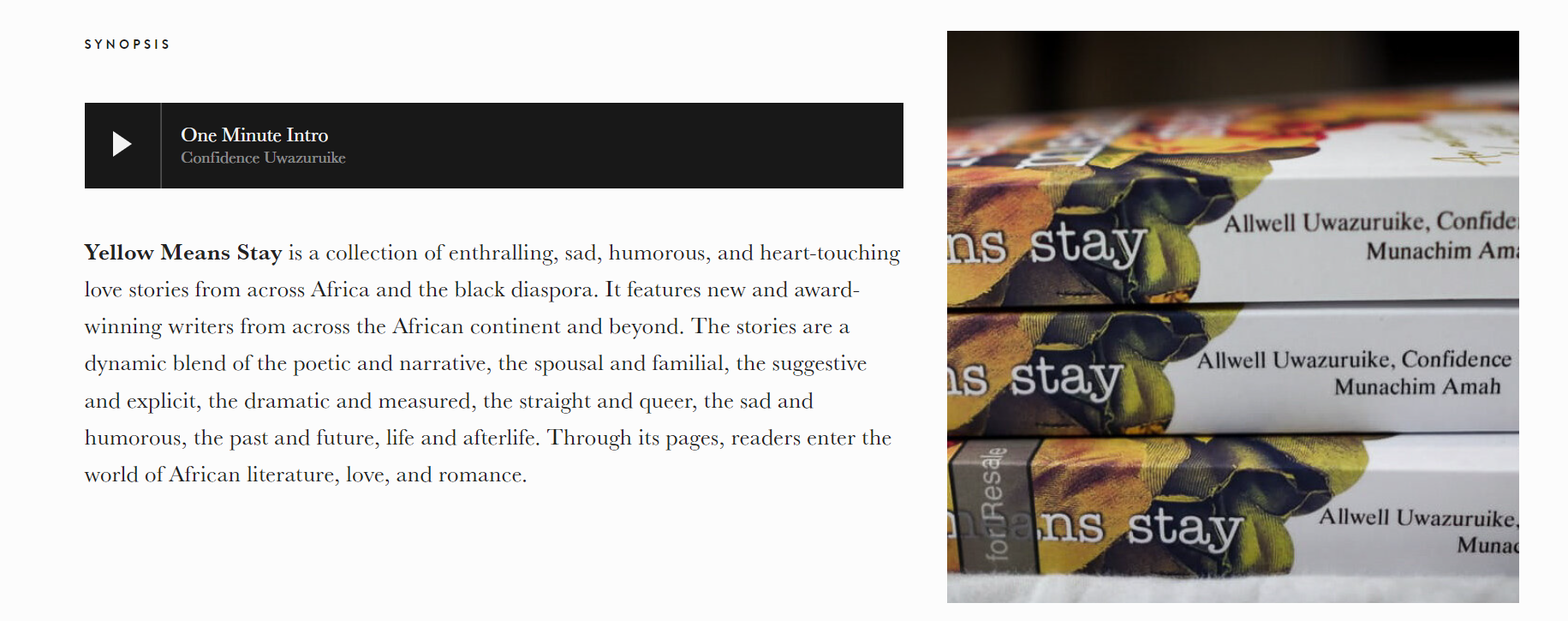
“Yellow Means Stay is a collection of enthralling, sad, humorous, and heart-touching love stories from across Africa and the black diaspora. It features new and award-winning writers from across the African continent and beyond. The stories are a dynamic blend of the poetic and narrative, the spousal and familial, the suggestive and explicit, the dramatic and measured, the straight and queer, the sad and humorous, the past and future, life and afterlife. Through its pages, readers enter the world of African literature, love, and romance.”
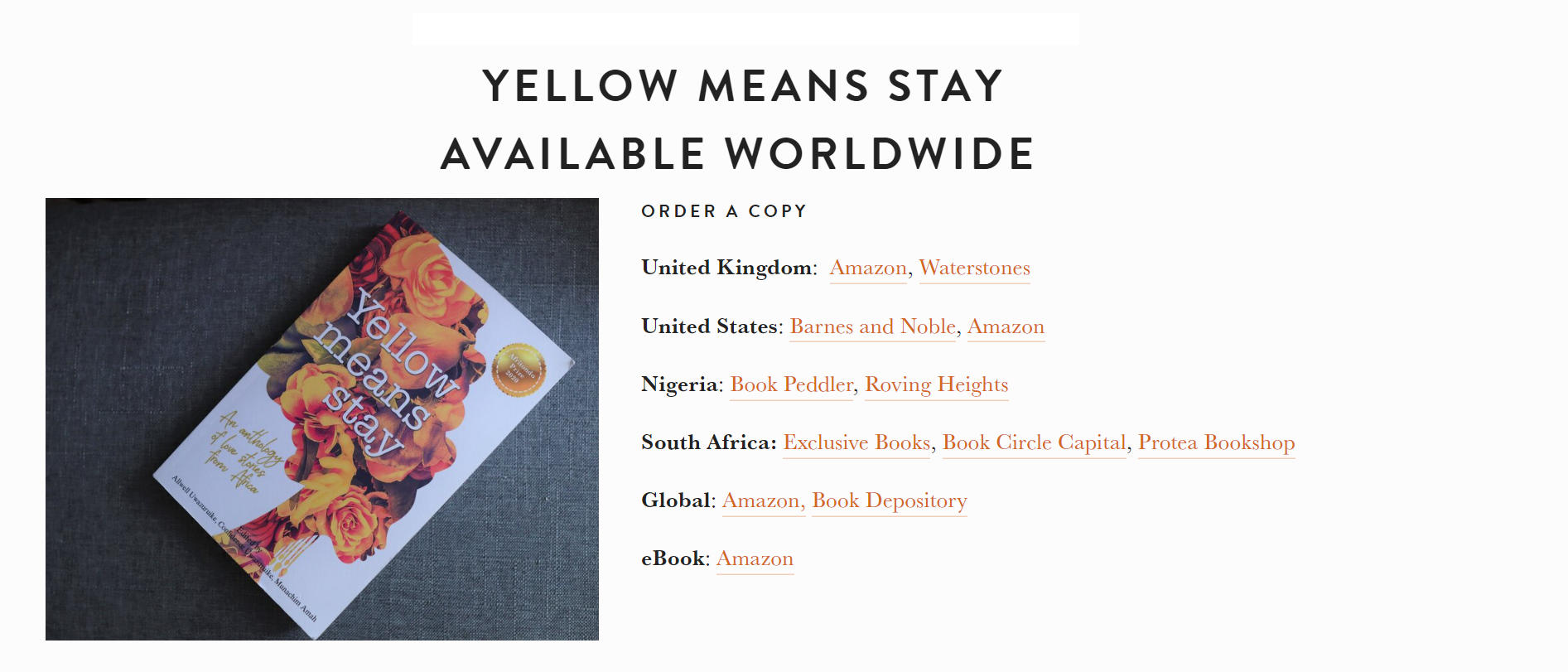
Available worldwide – order copies from Afritondo here.

Review: “What of This Fire, What of Butterflies?” – Yellow Means Stay, the 2020 Afritondo Prize Anthology. Part II.
AiW note: In the following “listicle style” Part II of Davina’s post, each of the 20 stories collected by Yellow Means Stay that are not her own are read, in brief, in the order they appear in the collection. This was the initially intended route she had planned to wander through, reviewing as a writer included in the anthology with her story ‘Touch Me Not’; but that was before she found her plan thwarted, gently redirected by the innovative capacities, both thematic and formal, of the other stories ‘Touch Me Not’ appears with. Crosscheck, re-find, pick a course and re-navigate the stories of Yellow Means Stay with part I of her writer-as-reader review pathways, as each expands the other…
II.
Yellow Means Stay features 21 stories, including by writers who have gone on to feature in prestigious and prominent awards for contemporary African literature:
Ifeoma Nwosu’s manuscript, ‘Solace,’ was longlisted for the 2019 Quramo Writers Prize, and Noel Cheruto won silver in the 2018 Short Story Day Africa competition. Phillippa Yaa de Villiers was a judge for the 2021 Luschei Prize for African Poetry. Rémy Ngamije was shortlisted for the 2021 AKO Caine Prize for African Writing and was the 2021 Commonwealth Short Story Prize Africa Regional Winner. Ani Kayode Somtochukwu won the inaugural 2021 James Currey Prize for African Literature and is longlisted for the 2022 Toyin Fálọlá Prize. Jarred Thompson is also longlisted for the 2022 Toyin Fálọlá Prize. Joshua Chizoma was shortlisted for the 2022 AKO Caine Prize.
- The protagonist of Rémy Ngamije’s (Namibia) ‘Only Stars Know the Meaning of Space’ evolves from taking turns being with her lover’s three personae – “He is a boy, a man, and a poet” (p.1) – to seeing (and loving) him for who he truly is, i.e. the kind of man who can “wrangle comets with his bare hands” (p.16).
- Slick Dog, the “ghetto herbalist” (p.23) from Philani Nyoni’s (Zimbabwe) ‘Slick Dog Diary of a Ninja,’ walks up “in one of those bullshit mornings” (p.18) unable to remember much, not even the name of the girl in his bed – the girl “with the beautifulness of an angel bathing” (p.26).
“‘I’m Mary.’ ‘Like the mother of Joseph?’ ‘No, you dunce, the mother of Jesus, wife of Joseph.’ ‘If Jesus was married, it wasn’t to a man.’ She’s hilarious to here this. ‘Mary. Enchanté.’” (p.26)
See part I of the review post for more on the direction resulting from Slick Dog’s irreverent word play. - Obioma Obinna Kelechi’s ‘The Weird and the Wired’ (Nigeria) opens with a description of a glamorous wedding reception: “Angels were watching them walk the aisle too. No, not the aesthetic effigy of cherubs with unflappable wings engraved on the church walls, keeping silent watch over the Blessed Sacrament draped in white, purple, and red linen in the chancel. No. These were real angels…” (p.32). When the priest asks if anyone has reasons why the couple should not be joined in holy matrimony, the protagonist speaks up: “Mooma, you can’t marry this dimwit” (p.33). The story sees things through to the end in the worst possible way: the affair between the bride, an older woman who likes being called ‘Mooma,’ and the protagonist, a younger man whose fantasies are fired up by the “incestuous ring” of “the mum-son tag” (p.35), devolves into a murder.
- The inaugural Afritondo Short Story Prize was won by Jarred Thompson (South Africa). His prize winning story, ‘Good Help Is Hard to Find,’ interrogates “…notions of privilege, especially white privilege, and class difference while also exploring the ways in which people from different backgrounds and different classes still depend on each other,” as he expressed in an interview on winning the Prize:
“I’m drawn to narrating queer lives in all forms and expressions. I’m also drawn to exploring the everyday. By this I mean speaking about those overlooked moments in our daily lives that really are beautiful if you look at them with fresh eyes. Because my own sexuality is seen as such a taboo in many places in the world, I am drawn to taboo topics and pushing the boundary in what literature can express or talk about” (“I bear witness to South African realities” 16 May, 2020).
Learn more about Thompson and ‘Good Help Is Hard to Find’ here and here, and read more of his writing here, here, and here. - Yagazie, the protagonist of Joshua Chizoma’s ‘Of Dead Things That Come Alive,’ (Nigeria) is “a man on a journey” (p.77). As he writes a letter to his wife, Kenechi, explaining his reasons for leaving her, he cuts a rueful figure; he wishes things had turned out differently – that he and Kenechi had been more sincere with themselves and each other. That way, he wouldn’t have had to find out from Facebook that Kenechi “loathed the institution of marriage” although when she “taught the women’s classes in Church” she spoke of “humility and submission and of Sarah who called her husband Lord” (p.66).
 Afritondo – https://www.afritondo.com/yellow-means-stay
- Abimbola Alaba’s ‘The Seeds of Pomegranates’ (United Kingdom) explores grief – “love that has nowhere to go” (p.114) – through flashbacks and flashforwards. Kunle and Laila’s beloved daughter, Ropo, named after “two women who died because they dared to give life” (p.111) is born in a state of emergency. On Ropo’s third birthday, Kunle instructs her to always remember that
“…you are Nigerian before you are a girl, before you are human. It is your creed and your religion. Let the eternal flame of this nation burn in your soul so that wherever you are, no matter what happens, you will always be aflame. A Nigerian soul cannot die. I love you” (p.111).
When Ropo is killed in a bomb blast in Sambisa, Kunle crumbles like the pomegranate seeds his mother liked to chew – “crushed mercilessly by cold, hard teeth in the damp darkness of a mouth” (p.113). - Deborah Vuha’s ‘Stimulus’ (Ghana) compels through a reminder that things are seldom what they seem; in a world where most aspects of life are visible on social media, the reasons why some people don’t enthusiastically exhibit their children may be more complex than we think. When Adjoa discovers that she’s pregnant, her mother suggests giving the baby up for adoption: “It can’t be heard that any child of mine had a baby out of wedlock. I can’t jeopardise my political ambition over your recklessness” (p.126). Adjoa, however, defies her mother and keeps the baby. When Adjoa’s son, who thinks she’s ashamed of him, runs away, she realizes that “the torture of carrying another person” (p.118) can manifest in ways that have nothing to do with pregnancy. Ultimately, she must choose between being a dutiful, fearful daughter and becoming a present parent.
- While mulling over the meaning of life, marriage, and materialism, the narrator in Noel Cheruto’s ‘Thursday Before Last’ (Kenya) accounts for his affair with a workmate he doesn’t deliberately go out looking to love, but who nevertheless makes him feel closest to God: “she told me she had forty-six possessions on earth—in the spirit of trying to keep herself light” (p.137). The narrator’s insight – that love, even the safe kind, can be wielded as a weapon – is addressed as much to his wife as to himself: “I loved your brand of broken, to be honest. It massaged my ego just right.” (p.143)
- In Cynthia Kistasamy’s ‘Shiva Eyes’ (South Africa), Prakash, the son of an orthodox Hindu priest, marries Chandra, who was “brought up in a home where religion was secondary to the other issues of life” (p.144). Although Prakash and Chandra have had “deep and meaningful conversations about their conflicting religious beliefs” (p.148), nothing prepares Prakash for the meat-eating fantasies that Chandra later indulges in. It gets so bad that she begins to see Titoo, the pet cow that’s beloved in her in-laws’ home, as “a giant piece of steak on legs” (p.151). Prakash eventually finds himself at a butchery, asking for a cut of the finest beef steak, since this seems to be the only way to slake Chandra’s fantasies. This “simple act of defying his parents” fills Chandra with “a new kind of love and appreciation” (p.154).
- Phillip Leteka’s ‘The Beast and the Boy Who Lives Close to My House’ (Lesotho) recovers deep and forbidden feelings, some of which the protagonist explores in “a somewhat pretentious philosophical ramble of reason” while telling himself that “humans are humans” (p.170). Although he insists that it is with humans rather than men or women that he falls in love, the textual (mis)alignment reveals a deeper understanding of his relationship with the boy that lives on the next street.
 Afritondo – https://www.afritondo.com/yellow-means-stay
 - In Phillipaa Yaa de Villiers’ ‘The Things Not Said’ (South Africa) Phillipe Muamba is enamoured of Dieuwke Beelaerts, the new girl at work who says she loves Africans and claims “colour is merely a manifestation of God’s imagination” (p.185). When Phillipe takes Dieuwke to the opera, he is touched by her boredom; he had assumed that “all European children were familiar with this high art” (p.187). Dieuwke accepts the necklace Phillipe gives her outside the concert hall, despite her aunt’s warning “about wearing jewellery ‘a man has bought for you’” (p.187), telling herself that the necklace is probably no more expensive than something from a flea market. Later, when Phillipe asks Dieuwke to go to Easter mass with him, it’s almost as if he’s asking her to move in with him.
- In Marline Oluchi’s ‘Lemon Drops’ (Nigeria), the essentialization of maternal love is problematized when a mother kills her daughter. The daughter’s death imprisons the mother as much as it frees her: “With just one action, the lives of so many people had been irrevocably changed. But now, I knew peace” (p.200). In her prison cell, the mother thinks about what she did, wondering if perhaps her mind exaggerated the severity of her daughter’s condition. “Maybe she would’ve grown up to chase the rainbow. Or maybe not. There was no room for maybes when the reality of her pain stared at me daily” (p.200). In the prison cell, the mother grants her daughter a place in this world: “Blankly staring down at my hands, I finally name her, Kamsisochukwu, How I follow God, but this time, by unfollowing him. Swirling it in my mouth, I taste her name and voice it out for the first time. Kamsisochukwu.” (p.201).
- The protagonist of Jennifer Yvette Terrell’s ‘Perhaps They Were Never Human’ (USA), Professor Esther Yochima Emil Dlamini, is due to give a lecture on 10th December, 2998; the lecture is part of a series meant to prepare for a global referendum on renaming the human species. The anticipated name change is doing more than creating tensions across all twelve diasporas; it is also affecting Felix, “the one person she called home” (p.204). Esther and Felix have become uneasy around each other because Felix’s “work and status are being challenged now that his declared love companion will become a face for this vote” (p.206). There’s also the possibility that “if the vote goes badly” Esther will become “the 30th century Eve from the Euro-Christian bible—offering knowledge when perhaps none was truly wanted, or rather, not wanted from a woman” (p.205).
- In Mazpa Ejikem’s ‘This One Is Mine’ (Nigeria), a part-time cleaner at a university leaves his lover, and Lagos, for a house he hasn’t been to in six years – a house full of painful memories: “I am thinking of everything now, and I feel the fibres of my mind starting to bend and crack in a way that threatens breakage” (p.237). Eventually, paranoia and fear drive him out of the house and into the middle of a road, where he dance-dances and his spirit joins his lover’s spirit: “he holds my head gently between his palms and kisses me back. Deeply. Until I am light, and I am floating, and I am convinced that I am God” (p.239).
- Ifeoma Nwosu’s ‘Remember Your Father’ (Nigeria), narrated through the point of view of seventy-year-old Mbelede, is a recollection of the events that led to an encounter with a boyish man who “appeared lifeless, white as nzu” (p.243). Mbelede and her sisters have gone to steal udala from Nyani Odumegwu’s farm when they stumble upon him. Mbelede’s curiosity (“What sort of man did not grow his beards? Could this be a woman?” (p.243)) prompts her to approach him and sit with him at the foot of the udala tree. When the man, Roger, shows Mbelede a history book, she’s shocked to learn that people can live on pages. Roger will later offer Mbelede a new beginning after her home, Aguleri, is ruined during a war for independence. As Mbelede confronts the emotions evoked by her memories, she concludes that “Home is not stationary. One does not leave one’s breasts when going out. One takes home with her, ruminating over history in her mind’s eye” (p.250).
 Afritondo – https://www.afritondo.com/yellow-means-stay
 - Edoziem Miracle’s ‘Like Pearls in an Ocean’ (Nigeria), which is set in 3091, when “it is better to be a myth than [to] be a man” (p.252), does more than think outside the box: it creates a new box through an airborne virus, Interfectorem hominum, which is “…unique to the anatomy of the human male” (p.254). Dalu, the protagonist, returns after a long day at work to an empty house. Dalu watches two hour-length movies, and finishes a plate of sliced cucumbers and fried groundnuts, while awaiting the return of Ike, his partner. When Ike finally shows up, he says his boss asked him to stay behind and eventually reveals that he had sex with her: “I was given no choice, Dalu. It was either that or I lose the job” (p.258).
- In Ani Kayode Somtochukwu’s ‘For Love is a Broken-winged Bird That Cannot Fly’ (Nigeria), Amara meets Ken at the faculty of biological science while he’s visiting Nedu. Since Amara is especially kind to Ken, he begins to think of her as “his bridge to God” (p.269), the “long-awaited answer to a sinking man’s fervent prayers” (p.271) – prayers concerning the love letters he wrote to Junior. Ken is with Amara, years after those letters, when he meets Ejike, who will eventually fill places in him that neither Amara’s good-naturedness nor God’s grace can reach.
- Nnamdi Anyadu’s ‘The Mask and the Woman’ (Nigeria), explores authenticity, artistic inspiration, and neo-colonialism through the relationship between Naro Wu and Tim Wu. Naro is meant to be writing an autofiction novel, which she began seven months ago, but “the words to tell it elude her” (p.289). One afternoon, when all Naro has managed to write is four sentences, she offers a slice of mango to a Benin Bronze, which she bought at an art exhibition, and prays to it for help with her writing. Tim’s suggestion that Naro prays for her brother-in-law, too, is met with laughter – “The Wu family doesn’t need prayers. And even if they did, she wouldn’t be able to help with that. Her own family had been pissed when she brought Tim home. Ibhafidon had said he could not believe his own sister wanted to marry a shylock. This is the derogation Nigerians adopted for the Chinese in the later 2080s. Shylocks—because they had come to collect what they were owed” (p.291).
- Kojo Obeng-Andoh’s ‘[Unknown] and Wife’ (Ghana) follows a “carnivorous, thirsty like a bloodhound” woman “who made sure she had come before she was done being fucked” (p.296) and her husband, a man who “was never enough for her” (p.297) and who is constantly annoyed by how other people think his wife’s insatiable thirst is an attractive, interesting, and endearing thing. Two people who haven’t yet realised that there are ways to be together without being man and wife. Two people who “like most people…couldn’t realise that marriage was not for them, that it would break them” (p.304).
- ‘Yellow Means Stay,’ Hannah Onoguwe’s titular story (Nigeria), is set in a place of transit – a world where buildings look like “images from a child’s picture book of the future” (p.316). A world where Abdulmalid (and not Peter) awaits your arrival at the gate, Angel Raphael wears dreadlocks, and Fela Kuti is “one of the few given a free run of the whole place” (p.325). It is in this place of transit that Ebimobowe Inuma, who thinks he’s dead, finds himself. When he’s shown a hologram of his wife and son at a fast food joint, discussing his chances of survival, he becomes privy to information that makes his legs tremble and scrambles his brain. On the bright side of things, he’s offered a glimpse of what intercourse is like in a place where marriage isn’t necessary:
“Jibike jerked him to his feet, with shocking strength, and fused her lips to his. Slicker than palm oil, they worked his in a way that made his nerve endings snap their eyes open and throw off their duvets. His palms itched to hold, to mould, but contented themselves with carving around her face and shoulders, his thumbs stroking her skin. But through the haze of desire, something was happening: it was like he’d been taken apart and melted and was being poured into her. Inside and out was searing heat, the pumping of blood, the hum of body systems running in tandem.” (p.323)
Afritondo – https://www.afritondo.com/yellow-means-stay
Order Yellow Means Stay, and find details of the 2021 and 2022 Prize anthologies: Rain Dance and The Hope, the Prayer, the Anthem, via Afritondo here.

 Follow Afritondo on Twitter, Facebook and Instagram for updates on publishing opportunities and prize competitions.
And for more from us on Afritondo’s work with African writing, see our recent twinned Q&As in our AKO Caine Prize shortlist series this year with Allwell Uwazuruike, co-founder of Afritondo – described there as “an online magazine for African politics and arts, including fiction, poetry, nonfiction, and essay” – and publisher of Joshua Chizoma’s 2022 AKO Caine Prize shortlisted story, ‘Collector of Memories’, which first appeared in the 2021 Afritondo Short Story Prize Anthology, The Hope, The Prayer, The Anthem (Afritondo).
In his Q&A, marking our first in the series of Caine Q&As where we’ve been able to spotlight the often less visible roles in prizes and prize cultures, Allwell talks about publishing Chizoma’s story, discussing publishing more generally and the work that Afritondo does for African writing, navigating the publishing industry as it is at the (still extraordinary) time of the interview, and ways we can support the work that Afritondo do.
NB: while we’re here – we also run a Q&A with Chizoma as part of the series, which you can follow links to via Allwell’s Q&A, and to our review of his story, ‘Collector of Memories’, written for us by Innocent Akili Ngulube, part of our now annual AKO Caine Prize coverage for its 2022 edition.


Categories: Reviews & Spotlights on...
Related Articles
-
 Spotlight on… Step back and step aside: Rereading Caroline Rooney on animism and African literature, a quarter of a century later
-
 Spotlight on… Fanny’s D’Or: Voice Against Blade
-
 Q&A: Spotlight Interview with Ellah Wakatama, Chair of the Caine Prize for African Writing
-
 Review: Nadia Davids’ ‘Bridling’ (on the Caine Prize Shortlist 2024)
 africainwords.com
join the discussion: