
AiW Guest: Beatrice Grace Munala.
AiW note: Today’s post continues our 2024 Caine Prize Shortlist Reviews series (in full with more here), as Beatrice Munala reviews Ghanaian writer Tryphena Yeboah’s shortlisted story, ‘The Dishwashing Women’, published in Narrative Magazine, in 2022.
NB: Our reviews may contain spoilers! Read ‘The Dishwashing Women’, available via the shortlisted stories page on the Caine Prize website.

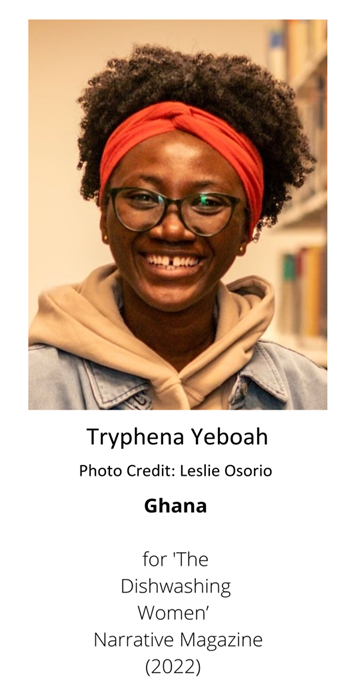
In elegant prose, “The Dishwashing Women” by Tryphena L. Yeboah explores the significance of being ‘at home’ through themes such as difference, discrimination, and, above all, the fierce power of love. We are introduced to two distinct socioeconomic classes of people, represented by a diplomat and his family, comprising the diplomat and his wife, and their two children, Samantha and toddler Ben, and the dishwashing women, Nkwa-daa, Esiha, and the younger Adoma, who are maids in the diplomat’s residence.
There is a “reckless” disparity between them, that the youngest maid Adoma recognises in the social arrangements in the house, which is there from the very start. Take the opening lines:
“AT FIRST THERE WAS one of them, and then two, and like a child that isn’t planned but also isn’t an accident, there was a third. They lived in a small kitchen inside a big kitchen. […] Adoma, the newest addition to the kitchen staff, did not want to believe it was the room assigned as the maids’ quarters. It was a tiny room compared to all the other rooms in the house. But the maids made a home of it, and when she would look around, Adoma was indeed surprised by their possessions—a stained velvet curtain that hung on the wall, a side table with a lampshade that had no bulb in it, old newspapers to wrap smoked fish in or fold in two as a hand fan when the heat was unbearable, a basket filled to the brim with aprons. So much of it secondhand treasures, and so many times their hands did the digging and salvaging from what would soon be discarded as worthless.”
Quoting in full here shows how Yeboah sets the scene for the entire story with the details of the older women’s capacity for homemaking because of their togetherness. This way, the fully exploitative nature of the relationships under the diplomat’s roof is revealed more slowly to us. It is also there from the start but runs under wider plotlines – the mysterious disappearance of a child and a separate but related revenge plot, that only come together in the very final sentences.
Indeed, from this beginning, Yeboah’s story expounds on the idea that, more than a house, place or material possessions, home is intimately tied to who you are close to. Given the temporary nature of residence for both diplomatic and domestic service, this is shown to be especially so for those to whom you can have physical proximity. On the one hand, the wealthy family unit lives in the same luxurious space, but each person seems to be experiencing some kind of loneliness that needs managing. Esiha and Nkwa-daa, on the other hand, are at home because of the strong bond of sisterhood they share: “To the women, home was never explicitly defined, but they knew they were seen by each other, that they could stretch their hand in the dark and another would reach out to hold it, that the unspoken rule was to keep watch and take care of your own, wherever they may be.”
In the process, a more complex picture of exploitation comes forward, underlining the structural, historical, and socio-economic basis of it. The dishwashing women in the diplomat’s house are casually taken advantage of: “Soon enough, with their secret recipes and many whispered recommendations to the cook about what local spices to use and the right amount of time to keep pastries in the oven, they had more to add to their workload, while their payment stayed the same.” The women’s concerns for Helen, Esiha’s daughter who is studying abroad, give away the persistent presence of a colonial past:
“They had the same thoughts, worried about Helen’s life abroad, if she was eating well and filling up her Rawlings chain—the visible and protruding collarbones of starving Ghanaians under Rawlings’s rule—and if she was staying warm and remembering their God.”
But it is the desire of the younger women from the lower class, Helen and the youngest maid in the household at 29, Adoma, to escape everything at home feeling “small, stifled and ordinary”, that reveals the most sinister aspect to life in the mansion.
The diplomat’s sexual exploitation of the girls who are desperate for a better life — Helen for a scholarship to study Psychology in the States, Adoma for escape from the poverty of the “small kitchen” subservience — is peeled away, like the secret of it happening, piece by piece. What actually takes place between Helen and the diplomat that means she is suddenly able to study in the U.S. is never stated but we come to see its repetitive nature: as Esiha and Nkwa-daa watch Adoma push in that direction, “[c]raving so boldly” the diplomat’s attention; and through Esiha’s guilt and instinctive understanding of the terrible secret that has broken the physical bond between her and her child.
Esiha’s pain at their separation is worsened by the fact that “Helen did it for a new country without her”. And when Helen gets to America to pursue her studies, she convinces herself that she has achieved everything she dreamed of, but she secretly yearns for home in the closeness her mother has with Nkwa-daa. Yet her search for this kind of friendship only reminds her of her alienation. This represents one of the strongest threads braiding through ‘The Dishwashing Women’. Yeboah further explores loneliness and the making of home through family, chosen and otherwise, in mothering, distance, absence, and grief. Nkwa-daa, Esiha, and the diplomat’s wife — all tell different stories of being in this role that Yeboah brilliantly brings together in the plot.
Ben, the diplomat’s son, finds comfort in the kitchen, “surrounded by women who saw him, tickled him, stuffed a tiny cornbread muffin into his small mouth every now and then, and threw him up in the air and caught him in their firm hands”. In the unfolding way Yeboah works her poetic prose, through these acts of mothering, we find out that Nkwa-daa and Esiha are also bonded by the maddening pain they have each experienced as a mother being separated from her child. Nkwa-daa nurses her friend through “love illness, the terrible condition of the heart where it convinces itself of its brokenness, its deep, incomprehensible calamities” because, as Yeboah shows us with deep tenderness and compassion, she knows the deep core of this illness’s shape. We learn that the Madam, “turning for the empty side of the mattress”, is human, well-meaning, even, when, observing the first time Nkwa-daa takes Ben to the park in a new informal nannying arrangement, “for a brief moment, one would think they had swapped places”.
We also learn what grief can push us to and where we will draw the line, where fire and anger give way to anguish, and the raw edges of silence and fear; we learn what we are willing to salvage, what our treasures are, what we can live with. As the narrative draws to a close, a much more painful sacrifice is laid bare at the door of the diplomat’s family. The depth of Yeboah’s insight and the skill with which it is crafted reveals a distillation of the humanity ‘The Dishwashing Women’ holds, against the unforgiving tide of “[t]he damaged past … a plague that attacks at all times”.
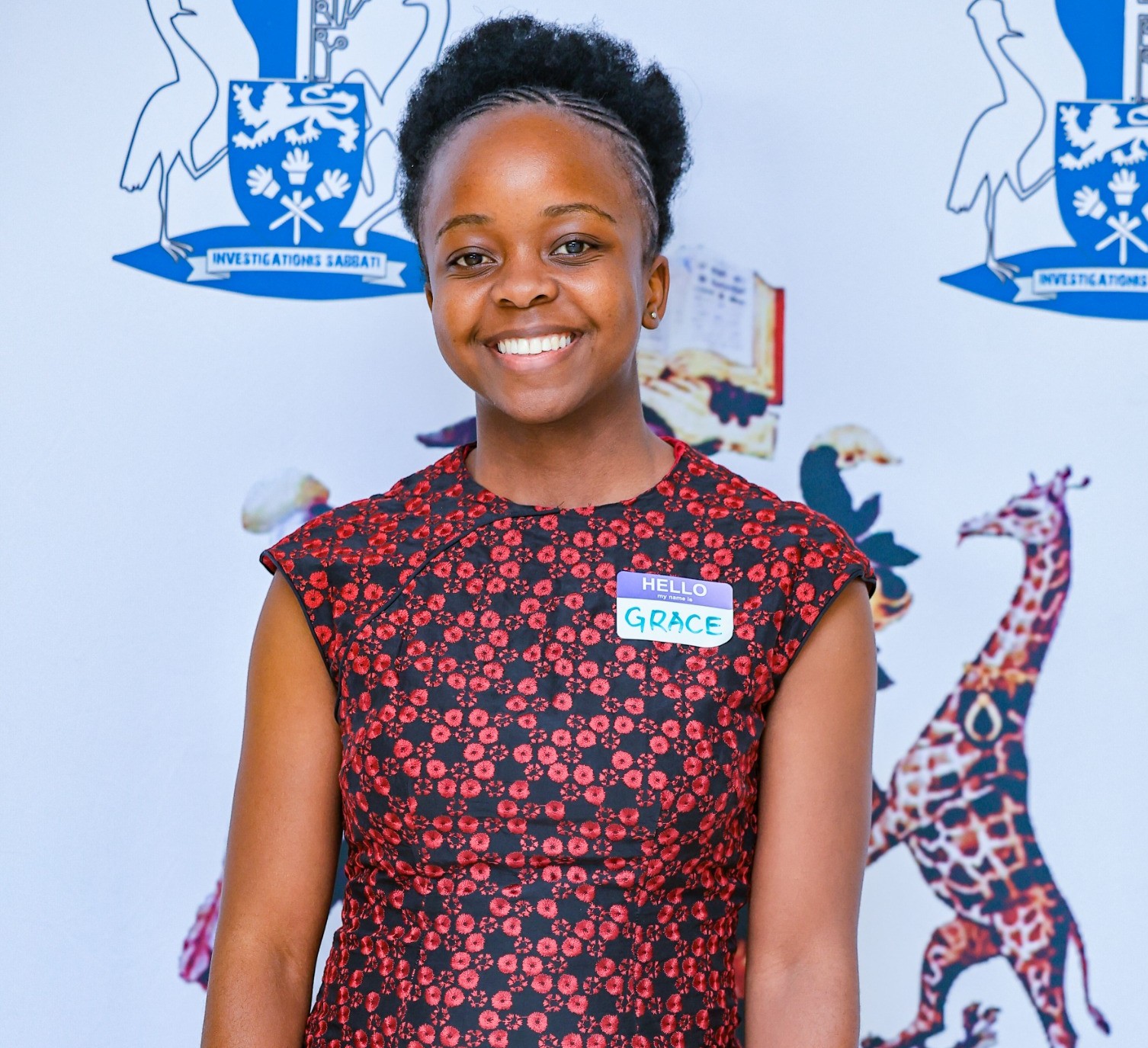
Beatrice Grace Munala is a teacher of Literature. She is an aspiring cultural literary studies scholar who is currently pursuing a PhD in Ancient Cultures at Stellenbosch University. Her research spins around how various forms of identities can be constructed from narrations about historical objects found in different cultural settings.

Tryphena Yeboah is a Ghanaian writer and the author of the poetry chapbook, A Mouthful of Home (Akashic Books). Her fiction and essays have appeared in Narrative Magazine, Commonwealth Writers, and Lit Hub, among others. She is an Assistant Professor of English and Creative Writing at Tennessee Wesleyan University.
Photo credit: Lesley Osorio.
For more on ‘The Dishwashing Women’ read Tryphena’s ‘Words On / Caine Prize’ 2024 Shortlist Q&A, which is ‘twinned’ with another complementary Q&A from the story’s publisher and editor at Narrative Magazine, Tom Jenks.
Read ‘The Dishwashing Women’, along with all the stories shortlisted for 2024, via the Caine Prize website, or by clicking direct on ‘Shortlist…The Stories’ image below.

For more on the 2024 shortlist and the changes to the format of the Prize, looking ahead to its anniversary edition in 2025, visit: https://www.caineprize.com/.
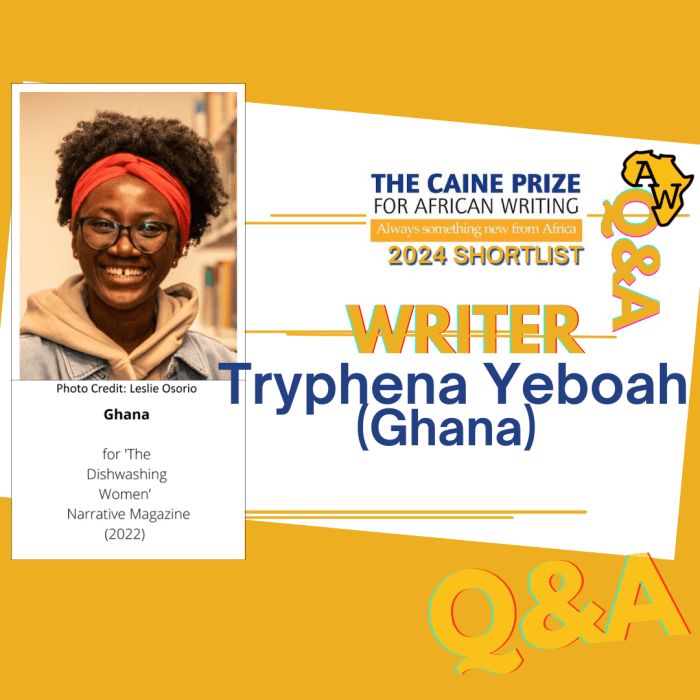

Tryphena Yeboah‘s ‘The Dishwashing Women’ – ‘Words On / Caine Prize’ 2024 Shortlist Q&As


All our ‘Words On / Caine Prize’ 2024 Shortlist Q&As
– find them, with all our coverage so far, here…
With thanks to all our Caine Prize 2024 Shortlist story reviewers this week; and special thanks to Wesley Macheso; and congrats to all those shortlisted for the 2024 Prize.
Categories: Reviews & Spotlights on...
Related Articles
-
 Spotlight on… Step back and step aside: Rereading Caroline Rooney on animism and African literature, a quarter of a century later
-
 Spotlight on… Fanny’s D’Or: Voice Against Blade
-
 Q&A: Spotlight Interview with Ellah Wakatama, Chair of the Caine Prize for African Writing
-
 Review: Nadia Davids’ ‘Bridling’ (on the Caine Prize Shortlist 2024)
 africainwords.com
splendid! 5 2025 Q&A: Spotlight Interview with Ellah Wakatama, Chair of the Caine Prize for African Writing refreshing