With AiW Guest: Chika Unigwe.

AiW note – on the 2024 edition of our, now annual, AiW Caine Prize series…
This week, our series of ‘Words on Q&As’ kick off a collaborative series based around the shortlist for the 2024 UK-based short story award, the Caine Prize for African Writing.
https://www.caineprize.com/press-releasesThis year’s competition witnessed a record-breaking number of submissions, with 320 entries spanning 28 African countries vying for the coveted prize, while also marking a significant milestone in the Caine Prize’s history as it enters its 25th year.
Moving with changes to the Caine Prize announcement format, our series will both look back over the 2024 Prize and ahead to the Prize’s 25th anniversary.
We’re starting today with a series of ‘Words On / Caine Prize‘ Q&As, featuring the 2024 Chair of the Judges, Chika Unigwe. Chika’s interview will be followed each day through the week with As to the same range of ‘Words On’ Qs: from the shortlisted writers; and, continuing our attention to the publication routes of African literary production, some of their publishers — all of which open up interviewees’ involvement in the 2024 Prize.
As with our previous coverage of the Prize, we spoke to our interviewees before the winner was announced on September 17th.
NB: We’re back to an extended Caine Prize series for its 2024 run. Watch this space for more in the coming weeks, including: one-a-day reviews of each of the shortlisted stories, guest authored by critics based on the continent, and commissioned by our own Wesley Macheso; as well as an insightful interview with the current Chair of the Caine Prize, Ellah Wakatama, in conversation with our resident publishing and prize industry specialist, Doseline Kiguru...


AiW: Thanks so much for speaking with us, Chika. As the 2024 Caine Prize Interim Director, Vimbai Shire has said, there is a thrilling and “diverse array of specialisms represented by the judges” on the panel this year. We are excited to share yours as Chair of the Judges, as well as your take on the 2024 Prize and your experience of the stories that have been part of it.
Could we open, please, with a bit of a picture of your chairing the judging panel for the 2024 Caine Prize for African Writing, perhaps something our readers might not yet know, or that they might need to, about literary prize panels and how they work? Are there any particular challenges, joys, or observations specific to this experience, this year, working with your fellow judges, that you would like to share with us?
Chika Unigwe: Thanks for this. Judging a story contest, especially one at the level of the Caine Prize, is difficult because there are so many good entries. The fact that it is open for published works already makes it selective, so you are getting stories of a certain standard. It makes the judging process both challenging and rewarding. The Caine Prize appoints judges from different areas – writers, musicians, artists etc. – which makes for interesting conversations when discussing the stories to make the longlist/shortlist and the winner. I loved talking about not only the stories we agreed on, but the ones we disagreed on as well. It was a wonderfully enriching experience.
Could you tell us about your work more broadly – with short story writing from the continent, but also any overlaps with the (other) kinds of work you do, the roles you hold, or the more general and different sorts of professional hats you wear — and how this may have played in to your experience of judging the stories this year?
I write fiction and nonfiction. I’ve published essays, novels, short stories, a short story collection, academic articles. I teach creative writing at Georgia College and State University, Milledgeville. I also love reading. I came to the judging as a reader who loves short stories and as a teacher-practitioner who understands craft. I can tell when a short story is doing what it set out to do, even if that short story isn’t a genre I would normally read. I can tell a strong story from a weak one regardless of theme or genre.
Looking to you as a reader, is there a serendipitous or interesting, perhaps even uncanny, book / text related thing that’s happened to you? Perhaps a happy, weird accident that has occurred around books or writing that you can share with us; or a strange, significant – outrageous, even – thing you have done, or would do, because of, or for a book (text / story / piece of writing)?
For On Black Sisters Street, my 2011 novel, I went to the red light district of Antwerp to talk to sex workers. Authenticity in writing is important to me, but you can’t write a character authentically if you know nothing at all about them. My characters are sex workers in Antwerp, and I had to be in that space to feel what they must have felt on their first day. When I wrote Sisi’s embarrassment in a café out of which undocumented sex workers operate, I translated my own self-consciousness while I was in a café very much like that one.
What are the most ethical and/or heart-lifting changes in practice you’ve seen happening across your industry/industries recently? What would you like to see become more visible and celebrated going forward (jobs, roles, avenues, practices)?
I was in Berlin recently and I met a Tanzanian publisher who also published work in translation, from English to Swahili. It is incredible to think of our works, written in English, being translated into an African language. It doesn’t happen often enough.
What would you say is the best investment you’ve made in your professional self / selves, or the most valued advice you’ve received about navigating your industry (or industries)?
The most valued advice is to be persistent and not be in a hurry. Keep doing the work and doors will open.
Finally, how can our blog, books, and online communities best offer support for your work with African writing?
Keep highlighting African writing and writers. Keep showing up for us. Keep making us visible. Keep inundating your space with all the different flavours and varieties of African writing so that the world sees that there isn’t one way of writing Africa.
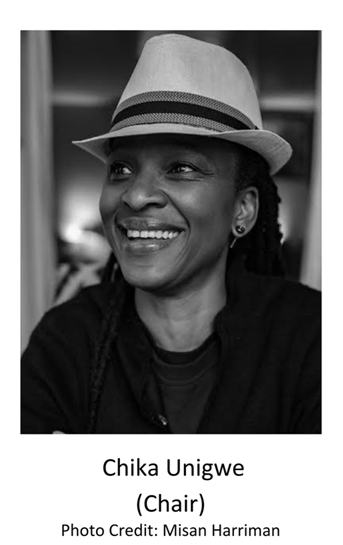
The 2024 Caine Prize Chair of Judges was award-winning Nigerian author Chika Unigwe. Unigwe serves as a creative writing professor at Georgia State College and University in Milledgeville, Georgia. She is a prolific writer of both fiction and nonfiction, whose works have been translated into several languages. Her notable works include the award-winning novel On Black Sisters’ Street and the short-story collection Better Never Than Late. Her latest novel, The Middle Daughter, is published by Canongate Books. In 2023, Unigwe was knighted into the Order of the Crown by the Belgian government in recognition of her contributions to literature.
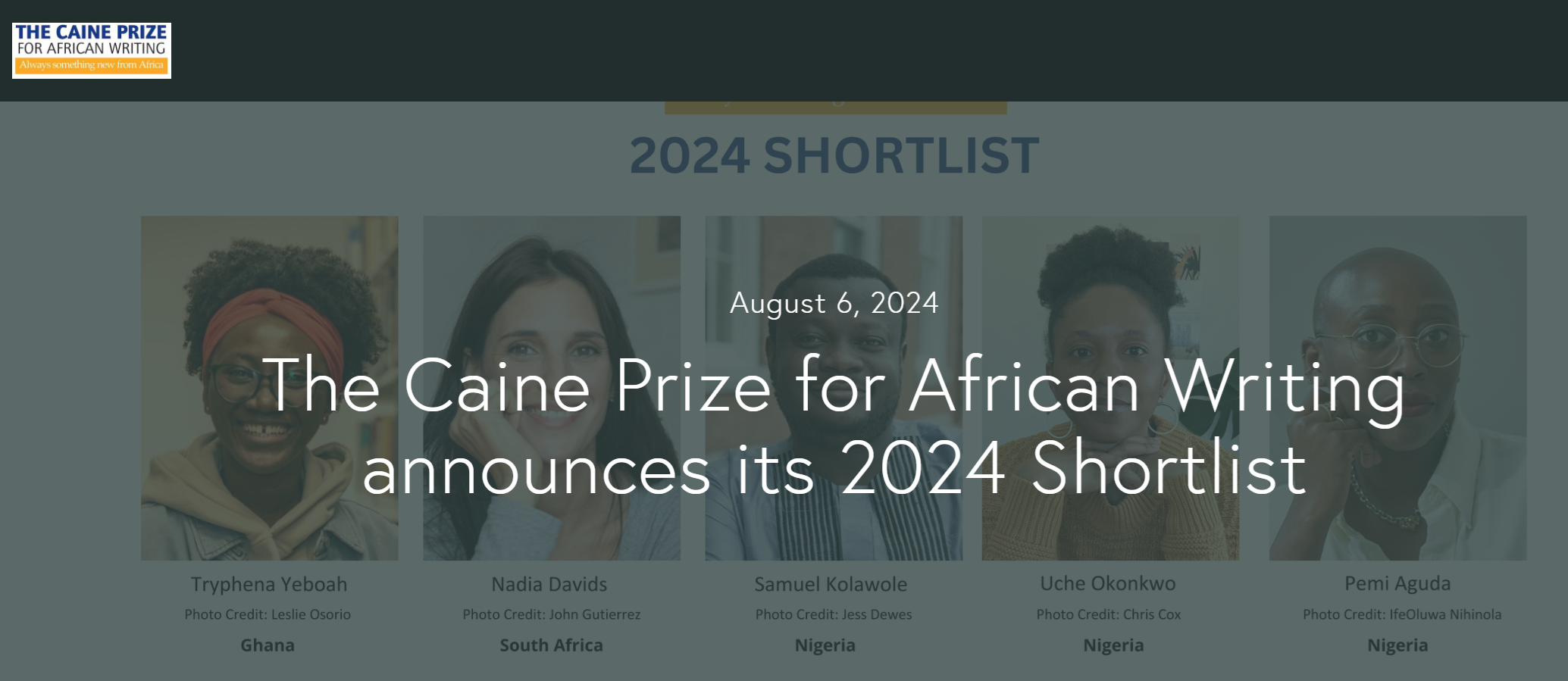
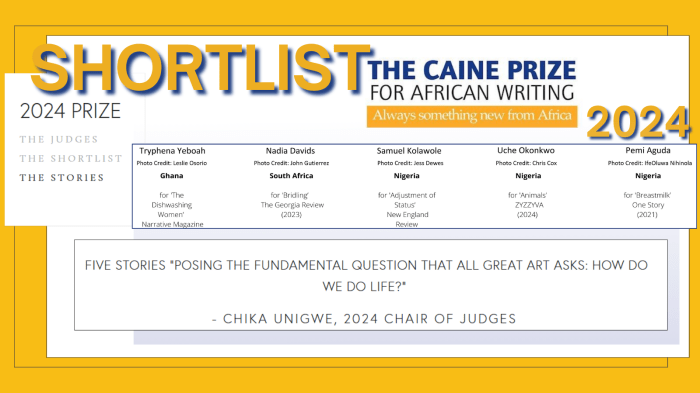
“…The shortlist and the honorable mention (Zimbabwe’s Yvette Ndlovu), span four countries and include writers at various stages of their promising careers […] ultimately posing the fundamental question that all great art asks: How do we navigate life?
Chika Unigwe, Chair of Judges, expresses her thoughts on the shortlist: https://www.caineprize.com/press-releases/2024/8/6/the-caine-prize-for-african-writing-announces-2024-shortlist
Get ahead of our next AiW Caine Prize Series posts — Q&As with the shortlisted writers and their publishers, and our specially commissioned reviews (running next week) — by reading all 5 of the stories shortlisted for this year’s Caine Prize via their website here, or by clicking on the 2024 ‘Shortlist…The Stories’ image below.
With congrats and thanks to all our Q&A Caine Prize Shortlist 2024 participants; our reviewers; and special thanks to Ajoke Bodunde and Ellah Wakatama at the Caine Prize.
Categories: Conversations with - interview, dialogue, Q&A, Words on the Times...
 Q&As: Uche Okonkwo’s ‘Animals’ – on the Caine Prize Shortlist 2024
 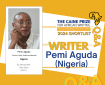 Q&As: ‘Pemi Aguda’s ‘Breastmilk’ – on the Caine Prize Shortlist 2024
  Q&As: Mame Bougouma Diene and Woppa Diallo – Caine Prize shortlist 2023 – winners
  Q&As: Jendella Benson – Judging the Caine Prize 2023
  africainwords.com
join the discussion: